Stage 1 – Incubation
The pieces of the coming techquake fell quietly into place, without fanfare, by 1978.
On a cool morning in Boston in the spring of 1978, Dan Bricklin sat in his financial modelling class at the Harvard Business School looking at the cells consisting of rows and columns the professor was working with on the extra large blackboard and peered at his handheld calculator. Watching the professor, Dan got the idea of a program that could automate these cells and he solidified his plans to use the gaming paddles on the Apple II during bike rides in Martha’s Vineyard. The Apple mouse was still a few few years away. No diskettes as yet either. Programs were loaded via a cassette player.
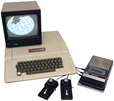
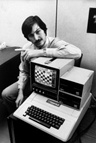
Early one January morning a young Steve wandered out of his crowded bedroom at Jobs’ parental home in Los Altos, grabbed an apple and opened the garage door for his friend and partner Steve Wozniak. ( The house was declared a historic site in 2013.) There was excitement in the air as they got ready to put the prototype Apple II’s latest design of a hobbyist’s dream appliance computer through its paces. Appliance? They wanted the Apple II to be a product that would look different and stand out and that real people outside the Homebrew Computer Club would want to own. Integrated keyboard and the first true color graphics display. No GUI (graphical user interface) as yet. A foam-molded plastic case, in just the right shape, size and color (beige) and no visible screws or bolts. Sleek. Integrated. Like some of the kitchen appliances Jobs looked at while in Macy’s combined with the influence of his life long interest in Zen. And the disruptor power of Disk II. No more loading applications via a cassette player. Wozniak worked through Christmas and New Year to develop the interface and it is one of his greatest contributions to computer technology.
As of 2013, sixty-three Apple I computers have been confirmed to exist. Only six have been verified to be in working condition.
Half way across the world, an IBM regional manager working on assignment in Calcutta for IBM India had just returned from the Golden Circle in Bangkok. He was celebrating his fifth top achiever sales year in a row. Life was good. Music circle. New friends. Business success.
But fate was about to intervene. IBM announced that they would be closing their India operations. Our regional manager was to return to the Armonk NY IBM World Trade Center as a senior product analyst. A new and very different beginning awaited my maternal uncle.
Stage 2 – Marriages Made in Tech Heaven
Remember how we got started,
Not so long ago.
Products come and products go,
In a matter of a year or so.
Departing, they leave behind their imprints
In the shifting sands of time.
For those that follow to build on
And improve until it is prime.
The Apple II prototype testing was successful. The IBM PC was still two years away. An eternity in the time compressed world of this revolution.
One day in 1979 a tall bearded young man (Dan Bricklin) came bouncing along the main corridor in the brand new Apple offices in Cupertino waving a diskette and saying that this, as yet unnamed program, would be the start of Apple’s revolution. A kind of visible calculator with rows and columns. It would only work on the Apple II and not on the other micros because it was the only microprocessor based computer with enough memory to run this software.
The two Steves had insisted on not cutting back, but building models of their Apple II that used the maximum amount of memory permitted by their CPU – 48 KB – even though it was more expensive to do so. Their gamble was about to pay off. The rule book was about to be flipped upside down. For the first time ever, software would sell hardware. The tail would wag the dog.
Businesses were lining up to buy the $2500 Apple II for their employees just so that they could run the $100 VisiCalc software (about $6000 / $400 in today’s dollars) – even if they owned other non-Apple computers and / or ran the rest of their business on IBM mainframes and mid range systems.
More than a million copies of VisiCalc were sold. So were $50 million worth of Apple II computers. Apple as a company was now on its way. The PC as a business tool had arrived. Such are the ways of a revolutionary product.
Dan Bricklin called their electronic spreadsheet software VisiCalc for visual calculator. So tremendous was its impact on the world of business that the Harvard classroom where the program was conceived is now known as the Bricklin Classroom and has a plaque for VisiCalc.
And yet it lived less than 5 years. It was the first successful software product to have gone through a complete life cycle, from conception in 1978 to introduction in 1979 to peak success in 1982 to decline and death in 1983.
Back then there was no patenting or protection granted for software programs. Software programs were thought to be mere mathematical algorithms, and mathematical algorithms, as laws of nature, were not patentable.
Alexa and Google Home and Apple Homekit. Security cameras, light switches and doorbells. ….. Home automation is everywhere today. But only a few of us may remember that the Apple II software stack also included home automation programs. Forever ahead of their times like true revolutionaries.
| CPU | MOS Technology 6502 |
|---|---|
| Memory | 48KB |
| Storage | Disk II (5.25″, 140KB) |
The first apple logo? Newton sitting under an apple tree. The rainbow colored partly eaten Apple logo came later with the introduction of color graphical display capabilities of the Apple computers.
Stage 3 – On a Clear Day …
I lived off of US 1 in the San Francisco of the early 80s. On a clear day you could see the blue of the Pacific Ocean two blocks west and the corner of the Golden Gate bridge from the bay window in the living room. This was before the tech billionaires and the venture capitalists. The average rental for a two-bedroom place was about $500. Bill Walsh and Joe Montana had just been recruited by the 49ers. Candlestick Park was still called Candlestick Park. And traffic was not forever gridlocked. You could still go down to Fisherman’s Wharf on the cable car and get fresh caught Dungeness crab and sourdough bread and walk over to the original Ghirardelli Chocolate Company Soda Fountain selling ice cream sundaes complete with their famous hot fudge chocolate sauce.
By late 1980 rumors, and rumors of rumors, of an IBM PC were flying around thick and fast. IBM had market share well north of 80 per cent with their mainframe computers for enterprise customers. Why would they want to risk diluting that? Nah. But Apple was growing its presence in the accounting and back office departments of those same customers. Hmmm. Around and around the rumor mill went.
My uncle came to visit me in the summer of 1981. I remember the icy cold Saturday morning with a thick, clammy fog rolling in to reduce visibility to close to zero as we sat with cups of instant Nescafe. Starbucks, as we know it, was not yet born. We talked about some of his latest product research projects. His research indicated that a program that was more portable and platform independent could potentially compete against VisiCalc. Not a legal issue since it wasn’t protected. We talked about how it would also have to be written tightly to run with fewer resources and respond faster. And have open APIs (application programming interfaces) for others to add functions.
We decided to program in Assembler on an Apple II that used CP/M from Digital Research as the OS. There was this startup called Micro-Soft (not a typo) run by Bill Gates that offered a version of DOS but CP/M was the most prevalent operating system for Microcomputers.
Working at architecting systems at the San Fransisco Fed during the day and teaching systems analysis at SFSU in the evening , I settled down to code at night and on weekends. We were looking to do a first beta test that winter and were to put out version 1 for investors in the next 6 months.
In the meanwhile Bill Gates put forward Multiplan with the capability to use larger sheets. However, it was poorly received.
So, on we went.
Stage 4 – Synchronicity
IBM put the swirling rumors emphatically to rest when it announced — “Presenting the IBM of Personal Computers – the IBM PC” (model 5150), code named Chess, on August 12, 1981 for a very competitively priced $1,500. Skeptics had claimed that IBM made decisions so slowly that, when tested, “what they found is that it would take at least nine months for them to ship an empty box”. But IBM the elephant had learned to dance. The IBM PC was designed and produced in 12 months. However, as we will explore further in the Wizards of OS, the IBM PC also changed the playing field, using PC-DOS from that startup Micro-Soft, and embracing an open architecture for the first time in its history. The display was wider so a larger spreadsheet could be shown. Memory could go up to 256 KB vs the old 48 KB.
A game changer. And back to the old drawing board for my uncle and me. I feverishly re-coded and revised on an newly purchased IBM PC. The investments were starting to mount !! We were targeting a first quarter announcement.
At the same time as us, Mitchell Kapor left VisiCalc and hired a staff of spreadsheet programmers to create a competitive spreadsheet product. He called his company Lotus Development Corporation. Their product was called Lotus 1-2-3 and was released on 26 January 1983 and was an instant hit and immediately surpassed VisiCalc in sales becoming the world’s third largest microcomputer software company in 1983 with $53 million in sales in its first year. (Their business plan called for revenues of $1M.) It was the first ever feature-heavy, user-friendly, reliable and WYSIWYG-enabled product to become widely available.
Lotus was late to release a 32-bit applications running on Windows 95 and was overtaken by Microsoft’s Excel. Sales fell. Lotus was acquired by IBM in 1995 who then sold to India’s HCL in 2018.
In 2003, Kapor became the founding chair of the Mozilla Foundation, creator of the web browser Firefox.
I joined IBM in June of 1983 and my uncle and I jointly spent 68 years with them.
My uncle’s product projection research had been spot on. I have been able to reuse the code segments for various spreadsheet projects, some of them award winning.
My uncle passed away a few years ago. I found his notebooks from our projects together and from his days in the Harvard MBA program. I still have them.
 Witness to the tech revolution